Harmonic Oscillator — Differentiable Time Evolution
The harmonic oscillator is a system that, when displaced from its equilibrium position, experiences a restoring force F proportional to the displacement x.
The equation can be derived by substituting Hooke’s Law into Newton’s Second Law F = ma.
where \(\vec{F}\) is force, \(k\) is the spring constant. and \(\vec{x}\) is displacement.
Deriving the General Solution
Substituting Hooke’s Law into Newton’s Second Law \(F = ma\) gives:
This is a second-order linear ODE. We define the angular frequency \(\omega\) to simplify notation:
So the equation becomes \(\ddot{x} = -\omega^2 x\). The general solution to this ODE is a superposition of sine and cosine with frequency \(\omega\):
where \(A\) and \(B\) are constants determined by initial conditions. Taking the derivative to get velocity:
Evaluating both at \(t = 0\) and applying \(x(0) = x_0\), \(\dot{x}(0) = v_0\):
Substituting back gives the complete closed-form solution:
Helper functions
def get_1d_array_length(x: ℝ[m]): ℝ:
total: ℝ = 0
temp: ℝ = 0
for i:
    temp = x[i]
    total += 1
return total

def zero_1d_array(len: ℝ): ℝ[m]:
    results: ℝ[len] = for i:ℕ(len) -> i*0
    return results

def zero_2d_array(rows: ℝ, cols: ℝ): R[m, n]:
    results: ℝ[rows, cols] = for i:ℕ(rows) -> for j:ℕ(cols) -> j*0
    return results
Gaussian Elimination
def solve(A: ℝ[m, m], b: ℝ[m]): ℝ[m]:
    n: ℝ = get_1d_array_length(b)
    Aug: ℝ[m, m] = zero_2d_array(n, n+1)
    result: ℝ[m] = zero_1d_array(n)
    # create augmented matrix
    for i:ℕ(n):
        for j:ℕ(n):
            Aug[i, j] = A[i, j]
        Aug[i, n] = b[i]
    # convert into upper triangular matrix
    for pivot:ℕ(n):
        for i:ℕ(pivot+1, n):
            factor = Aug[i, pivot] / Aug[pivot, pivot]
            for j:ℕ(pivot, n+1):
                Aug[i, j] = Aug[i, j] - factor * Aug[pivot, j]
    # back substitution
    for i:ℕ(n):
        ri = n - 1 - i
        result[ri] = Aug[ri, n]
        for j:ℕ(ri+1, n):
            result[ri] = result[ri] - Aug[ri, j] * result[j]
        result[ri] = result[ri] / Aug[ri, ri]
    return result
The algorithm proceeds in three phases:
Augmented matrix — the coefficient matrix \(A\) and the right-hand side vector \(b\) are merged into a single matrix called as Augmented matrix.
Forward elimination — for each pivot row, all entries below the diagonal are zeroed out by subtracting a scaled multiple of the pivot row from every row below it, producing an upper triangular matrix.
Back substitution — After we get the upper triangular matrix, we first calculate the value of the last variable. Then plug this value to find the value of next variable. Then plug these two values to find the next variables.
In the specific case of the Simple Harmonic Oscillator, the system of equations we are solving is:
Since the coefficient matrix is already diagonal, we don’t strictly need solve() here, as the variables \(a\) and \(b\)
are already decoupled. It is not needed in this case, but we are providing it as a pedagogical example for the general case.
Time Evolution
The time evolution operator \(U\) encodes the full solution directly,
using solve() to determine the coefficients from initial conditions:
def U(k: ℝ, m: ℝ, t: ℝ, x0: ℝ, v0: ℝ): ℝ:
    omega: ℝ = (k / m) ** 0.5
    A: ℝ[2, 2] = [[1.0, 0.0], [0.0, omega]]
    B: ℝ[2] = [x0, v0]
    coeffs: ℝ[2] = solve(A, B)
    a: ℝ = coeffs[0]
    b: ℝ = coeffs[1]
    return a * cos(omega * t) + b * sin(omega * t)
Physical Constants and Initial Conditions
k: ℝ = 1.0    # spring constant (N/m)
m: ℝ = 1.0    # mass (kg)

x0: ℝ = 1.0   # initial displacement (m - meter)
v0: ℝ = 0.0   # initial velocity (m/s)

U(k, m, 0.0 , x0, v0) # t = 0 * π
U(k, m, 1.5708, x0, v0) # t = π / 2
U(k, m, 3.1416, x0, v0) # t = π
U(k, m, 4.7124, x0, v0) # t = 3 * π / 2
U(k, m, 6.2832, x0, v0) # t = 2 * π
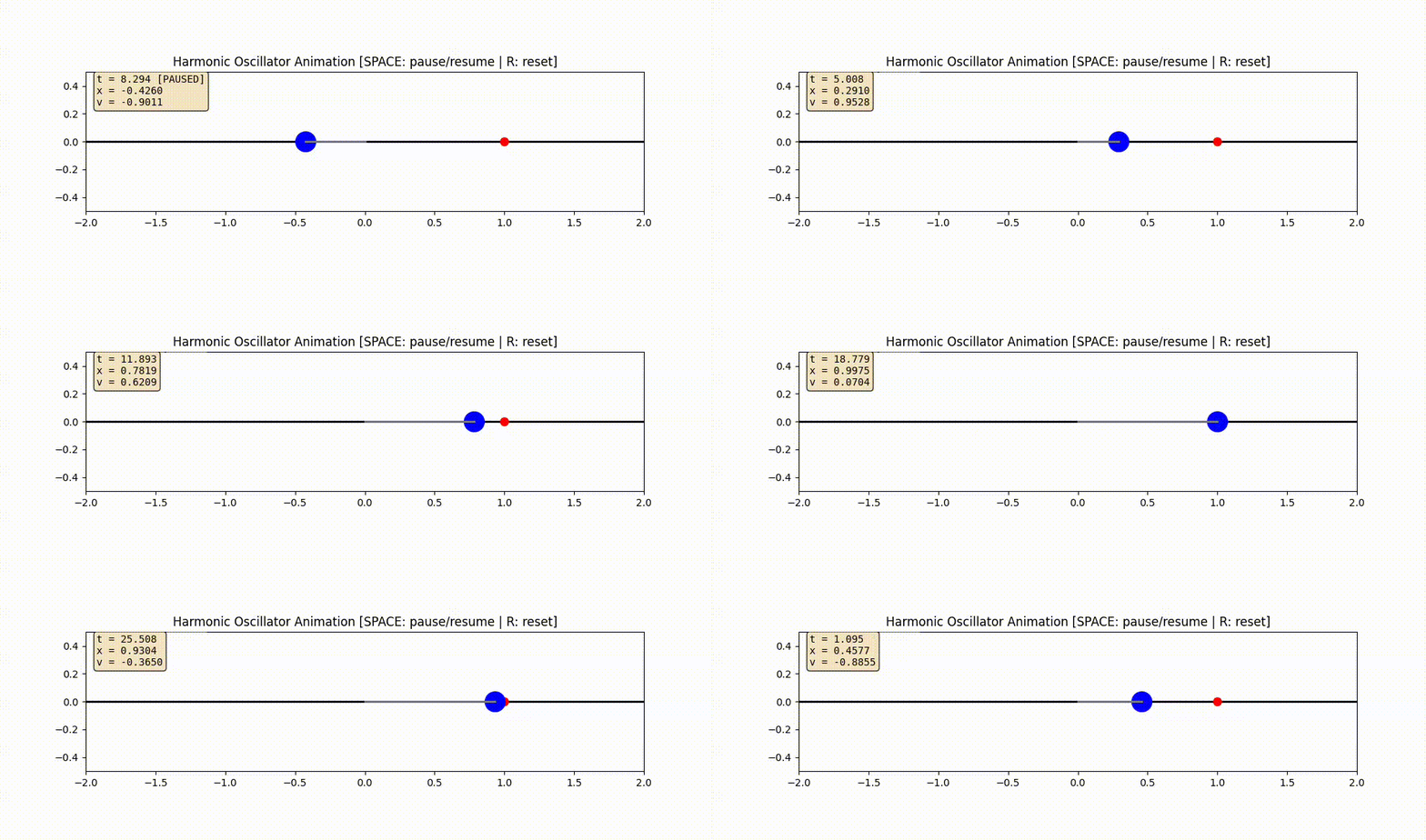
Visualize oscillation
animate(U, k, m, x0, v0, 0.0, 31.1416) # evolve over 10π
Note
animate() is available as a built-in function in runtime.py.
Velocity via Differentiation
Since \(U\) is a differentiable function of \(t\), the velocity is simply its derivative:
t0: ℝ = 0.0
grad(U(k, m, t0, x0, v0), t0)

t1: ℝ = 1.5708
grad(U(k, m, t1, x0, v0), t1)

t2: ℝ = 3.1416
grad(U(k, m, t2, x0, v0), t2)