Parameter Learning of the Schrödinger Equation
In this tutorial we will learn how to estimate the parameter of the time-dependent Schrödinger equation using gradient descent in Physika. The Schrödinger equation is a partial differential equation that governs the evolution of the wave function of a non-relativistic quantum-mechanical system. A non-relativistic quantum mechanical system is one where the particle moves at speeds much slower than the speed of light, so relativistic effects can be safely ignored. In this regime the Schrödinger equation is the right tool - it describes everyday quantum phenomena like electrons in atoms, particles trapped in a well, and tunnelling through a barrier. Here we simulate a Gaussian wave packet interacting with a potential barrier and recover the barrier height from obser.ved wavefunction data.
The Equation
The time-dependent Schrödinger equation is:
where:
\(\psi(x, t)\) is the wavefunction - a complex-valued field whose squared modulus \(|\psi|^2\) gives the probability density of finding the particle at position \(x\) at time \(t\)
\(\hbar\) is the reduced Planck constant
\(\hat{H}\) is the Hamiltonian operator - the total energy of the system
The Hamiltonian
The Hamiltonian splits into kinetic and potential energy:
Substituting into the Schrödinger equation:
Rearranging for \(\frac{\partial \psi}{\partial t}\) — the quantity we need for time-stepping:
This is the RHS of the Schrödinger equation - the rate of change of the wavefunction at each point in space.
Helper functions
def zero_1d_array(len: ℝ): ℝ[m]:
    results: ℝ[len] = for i: ℕ(len) -> i*0
    return results

def linspace(start: ℝ, end: ℝ, n: ℕ): ℝ[n]:
    x: ℝ[n] = zero_1d_array(n)
    dx: ℝ = (end - start) / (n - 1)
    for i:ℕ(0, n):
        x[i] = start + i * dx
    return x

def get_1d_array_length(x: ℝ[m]): ℝ:
    total: ℝ = 0
    temp: ℝ = 0
    for i:
        temp = x[i]
        total += 1
    return total

def get_2d_array_num_rows(x: ℂ[m, n]): ℝ:
    total: ℝ = 0
    temp: ℝ = 0
    for i:
        temp = x[i]
        total += 1
    return total

def zero_complex_2d_array(rows: ℝ, cols: ℝ): ℂ[m, n]:
    results: ℂ[rows, cols] = for i:N(rows) -> for j:N(cols) -> j * 1j
    return results

def append_row(x: ℂ[m, n], row: ℂ[n]): ℂ[k, n]:
    rows: ℝ = get_2d_array_num_rows(x)
    cols: ℝ = get_1d_array_length(x[0])
    new_rows: ℝ = rows + 1
    new_array: ℝ[new_rows, cols] = zero_complex_2d_array(new_rows, cols)
    for i:ℕ(0, rows):
        for j:ℕ(0, cols):
            new_array[i, j] = x[i, j]
    for j:ℕ(0, cols):
        new_array[rows, j] = row[j]
    return new_array
Grid and Physical Constants
Nx: ℕ = 1024
x: ℝ[Nx] = linspace(-200, 200, Nx)
dx: ℝ = 0.3910

hbar: ℝ = 1.0
mass: ℝ = 1.0
The timestep is chosen using the CFL (Courant–Friedrichs–Lewy) stability condition. The CFL condition is a constraint on the timestep \(\Delta t\) relative to the spatial spacing \(\Delta x\) - if the timestep is too large, numerical errors grow unboundedly and the simulation blows up. For the Schrödinger equation the condition takes the form:
where \(\alpha = 0.2\) is the CFL factor. Keeping \(\alpha\) well below 1 ensures the wavefunction evolves stably without numerical blow-up:
cfl_factor : ℝ = 0.2
dt: ℝ = cfl_factor * (mass * dx**2) / hbar
t_final: ℝ = 100.0
Nt: ℕ = 3271
The Initial Condition — Gaussian Wave Packet
We initialize the wavefunction as a Gaussian wave packet:
This is a product of three parts:
\(\frac{1}{\sqrt{\sigma\sqrt{\pi}}}\) :- normalization factor ensuring \(\int |\psi|^2 dx = 1\), so the total probability of finding the particle somewhere is 1
\(\exp(ik_0 x)\) :- a plane wave with wavenumber \(k_0\), giving the packet a mean momentum \(p = \hbar k_0\) and making it travel in the positive \(x\) direction
\(\exp\!\left(-\frac{(x-x_0)^2}{2\sigma^2}\right)\) :- a Gaussian envelope centred at \(x_0\) with width \(\sigma\), localising the particle in space
x0: ℝ = -50.0    # initial position
k0: ℝ = 2.0      # wavenumber (controls momentum)
sigma: ℝ = 10.0     # width of the wave packet

psi0: ℂ[Nx] = (1 / sigma*sqrt(3.14))**0.5 * exp(1j * k0 * x) * exp(-((x - x0)**2) / (2 * sigma**2))
Discretizing the RHS
We discretize space into \(N_x\) points with uniform spacing \(\Delta x\). The wavefunction becomes a vector \(\psi_i = \psi(x_i, t)\), and the continuous spatial derivative \(\frac{\partial^2 \psi}{\partial x^2}\) is replaced by a finite difference stencil that only uses the values at neighbouring grid points. This turns the PDE into a system of ODEs - one per grid point
Step 1 — Discretize the second spatial derivative
Using centered finite differences:
Step 2 — Apply the kinetic energy operator
Substituting the finite difference approximation into the kinetic term:
Step 3 — Apply the potential energy operator
The potential term is a pointwise multiplication:
Step 4 — Assemble the full discretized Hamiltonian
Combining kinetic and potential terms:
Step 5 — Compute the full RHS
Dividing by \(i\hbar\):
This maps directly to schrodinger_rhs. The roll operation shifts the
array by one index to access \(\psi_{i-1}\) and \(\psi_{i+1}\) for
all spatial points simultaneously:
def schrodinger_rhs(psi: ℂ[m], V: ℝ[n], dx: ℝ, hbar: ℝ, mass: ℝ): ℂ[o]:
    psi_xx: ℂ[Nx] = (roll(psi, -1) - 2*psi + roll(psi, 1)) / (dx**2)
    H_psi: ℂ[Nx] = -(hbar**2 / (2*mass)) * psi_xx + V * psi
    result: ℂ[Nx] = -1j / hbar * H_psi
    return result
Potential Barrier
We place a rectangular potential barrier of height \(V_0\) centred at \(x = 0\):
When the wave packet hits this barrier, part of it is reflected and part tunnels through. The ratio of transmitted to reflected probability depends sensitively on \(V_0\), which is why it is a learnable parameter.
def make_potential(V_value: ℝ): ℝ[m]:
    x: ℝ[Nx] = linspace(-200, 200, Nx)
    V: ℝ[Nx] = zero_1d_array(Nx)
    for i:ℕ(0, Nx):
        if abs(x[i]) < 15:
            V[i] = V_value
    return V
The RK4 Solver
Because \(\psi\) is complex-valued, the RK4 solver operates on complex arrays. The structure is identical to the wave equation solver — only the RHS function changes:
def RK4_step(psi: ℂ[m], dt: ℝ, V: ℝ[n], dx: ℝ, hbar: ℝ, mass: ℝ): ℂ[o]:
    k1: ℂ[Nx] = schrodinger_rhs(psi, V, dx, hbar, mass)
    k2: ℂ[Nx] = schrodinger_rhs(psi + 0.5 * dt * k1, V, dx, hbar, mass)
    k3: ℂ[Nx] = schrodinger_rhs(psi + 0.5 * dt * k2, V, dx, hbar, mass)
    k4: ℂ[Nx] = schrodinger_rhs(psi + dt * k3, V, dx, hbar, mass)
    psi_next: ℂ[Nx] = psi + (dt / 6.0) * (k1 + 2 * k2 + 2 * k3 + k4)
    return psi_next
The full solver runs the wave packet forward in time, storing a snapshot every 5 steps to build the history:
def solver(V: ℝ[m]): ℝ[m]:
    x: ℝ[Nx] = linspace(-200, 200, Nx)
    psi0: ℂ[Nx] = ((1 / sigma*sqrt(3.14)) ** 0.5 * exp(1j * k0 * x) * exp(-((x - x0) ** 2) / (2 * sigma**2)))
    psi: ℂ[Nx] = psi0
    history: ℝ[1] = [0]
    counter: ℕ = 0
    for i:ℕ(0, Nt):
        psi = RK4_step(psi, dt, V, dx, hbar, mass)
        counter = counter + 1
        if counter == 5:
            history = append_row(history, psi)
            counter = 0
    return history
Note
The current implementation of append_row can become a performance bottleneck for long simulations. To speed up
training, replace append_row with append_row_runtime inside the solver
function and add the following implementation to physika/runtime.py.
def append_row_runtime(arr, val):
    # val is an array — stack as new row
    if isinstance(arr, torch.Tensor) and arr.dim() == 1 and arr.shape[0] != val.shape[0]:
        # first call — arr is placeholder [0], start fresh
        return val.unsqueeze(0)
    elif isinstance(arr, torch.Tensor) and arr.dim() == 2:
        return torch.cat([arr, val.unsqueeze(0)], dim=0)
    else:
        return val.unsqueeze(0)
Generate Ground Truth Data
We fix the true barrier height at \(V_0 = 1.8\) and run the solver to produce the ground truth wavefunction history:
V: ℝ[Nx] = make_potential(1.8)
true_values: ℂ[m, n] = solver(V)

create_plot(true_values, psi0, x, V)
Note
create_plot is not a built-in Physika function. Add the
following helper function to physika/runtime.py:
import numpy as np
import matplotlib.pyplot as plt
from matplotlib import animation

def update(frame, true_values, psi, line_prob, line_re, line_im):
    """
    Evolves the wave function for several time steps per frame to smooth the animation,
    and updates the probability density and real/imaginary parts of the wave function.
    """
    psi = true_values[frame]

    # print((psi.real**2+psi.imag**2).sum())
    line_prob.set_ydata(np.abs(psi) ** 2)
    line_re.set_ydata(np.real(psi))
    line_im.set_ydata(np.imag(psi))
    return line_prob, line_re, line_im


def initialize_plot(psi0, x, V):
    """
    Sets up the figure and initial plots for the animation.
    """
    fig, (ax_prob, ax_reim) = plt.subplots(2, 1, figsize=(10, 8), sharex=True)

    V_scale_prob = np.max(np.abs(psi0)) ** 2 * 1.5
    V_scale_reim = np.max(np.abs(psi0)) * 1.5

    ax_prob.plot(x, V / 1.8 * V_scale_prob, "k--", lw=1.5, label="Potential")
    (line_prob,) = ax_prob.plot(
        x, np.abs(psi0) ** 2, "b-", lw=2, label=r"$|\psi(x,t)|^2$"
    )
    ax_prob.set_ylabel(r"$|\psi(x,t)|^2$")
    ax_prob.set_title("Quantum Tunneling")
    ax_prob.legend(loc="upper right")

    ax_reim.plot(x, V / 1.8 * V_scale_reim, "k--", lw=1.5, label="Potential")
    (line_re,) = ax_reim.plot(x, np.real(psi0), "b-", lw=2, label=r"Re{$\psi$}")
    (line_im,) = ax_reim.plot(x, np.imag(psi0), "r-", lw=2, label=r"Im{$\psi$}")

    return fig, line_prob, line_re, line_im


def create_plot(true_values, psi0, x, V):
    true_values = true_values.detach().cpu().numpy()
    psi0 = psi0.detach().cpu().numpy()
    x = x.detach().cpu().numpy()
    V = V.detach().cpu().numpy()
    fig, line_prob, line_re, line_im = initialize_plot(psi0, x, V)

    # Create animation for the live display.
    ani = animation.FuncAnimation(
        fig,
        update,
        fargs=(true_values, psi0, line_prob, line_re, line_im),
        frames= len(true_values),
        interval=30,
        blit=False,
    )

    plt.tight_layout()
    plt.show()
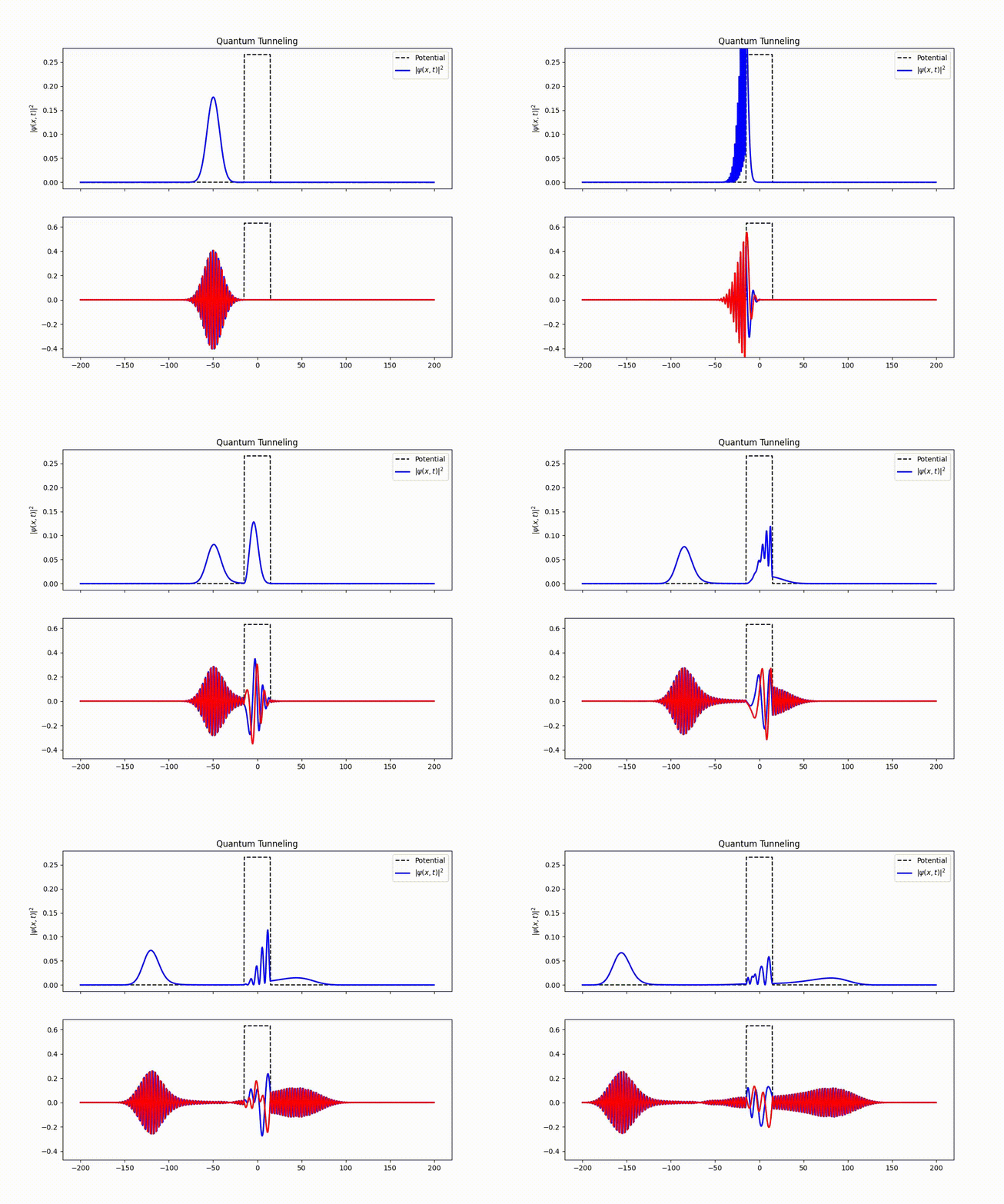
ground truth animation
Intial guess
guess_barrier_height: ℝ = 6.0
guess_V: ℝ[Nx] = make_potential(guess_barrier_height)
guess_values: ℂ[m, n] = solver(guess_V)
create_plot(guess_values, psi0, x, guess_V)
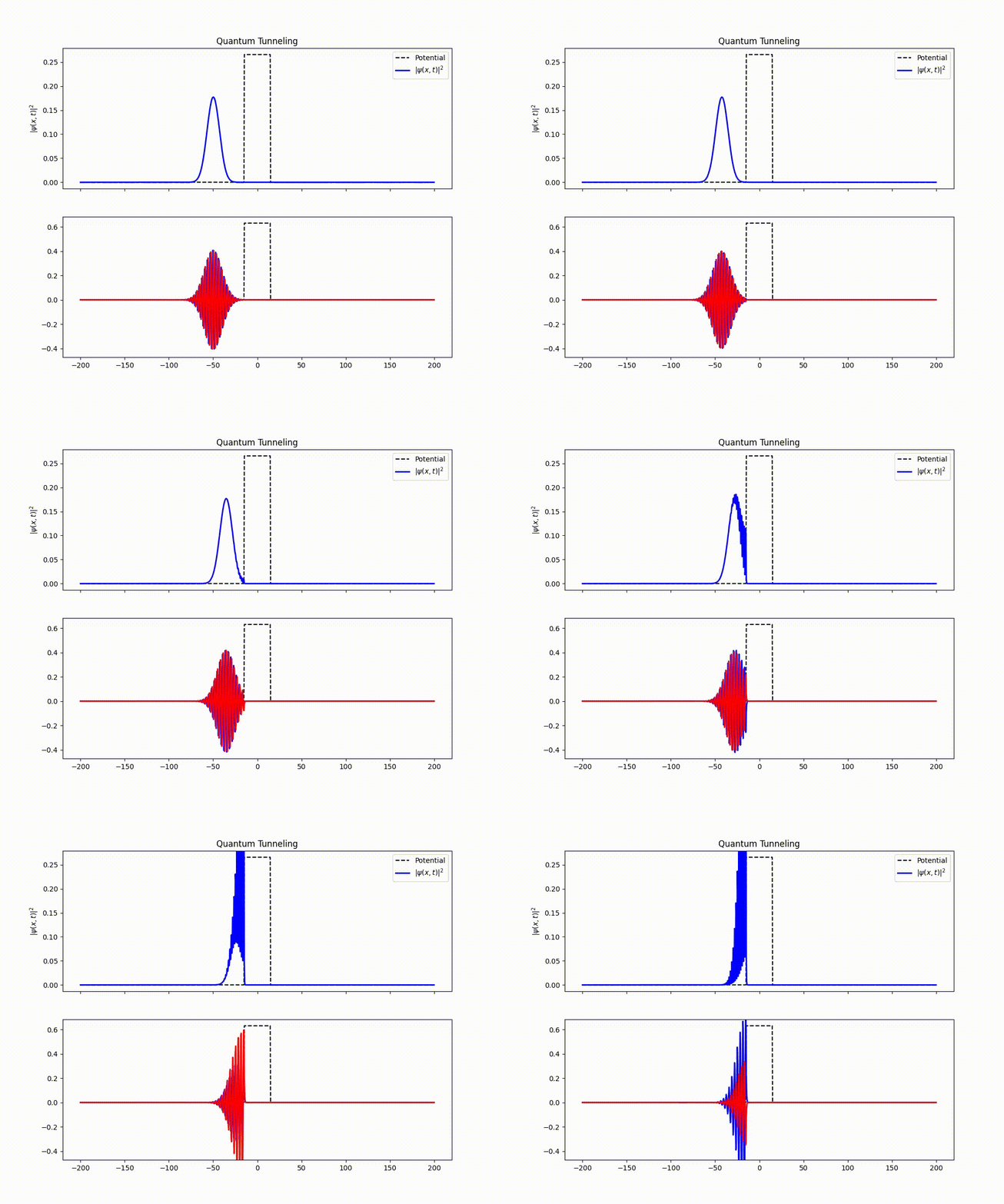
Initial guess animation
Define the Loss
Since \(\psi\) is complex, we cannot square the difference directly. Instead we take the absolute value first, which gives the magnitude of the complex difference at each point, then square it:
def calculate_loss(barrier_height: ℝ): ℝ:
    V_current: ℝ[Nx] = make_potential(barrier_height)
    pred: ℂ[m, n] = solver(V_current)
    loss: ℝ = mean(abs(pred - true_values)**2)
    return loss
The Adam Optimizer
We use Adam instead of plain gradient descent because the loss landscape for the barrier height is nonlinear and benefits from adaptive learning rates:
def adam(bh: ℝ, g: ℝ, m: ℝ, v: ℝ, t: ℝ, lr: ℝ) : ℝ[4]:
    beta1: ℝ = 0.9
    beta2: ℝ = 0.999V: ℝ[Nx] = make_potential(1.8)
    eps: ℝ = 1e-8
    m_new: ℝ = beta1 * m + (1.0 - beta1) * g
    v_new: ℝ = beta2 * v + (1.0 - beta2) * g**2
    m_hat: ℝ = m_new / (1.0 - beta1**t)
    v_hat: ℝ = v_new / (1.0 - beta2**t)
    bh_new: ℝ = bh - lr * m_hat / (sqrt(v_hat) + eps)
    return [bh_new, m_new, v_new, t + 1.0]
Training Loop
Starting from an initial guess of \(V_0 = 6.0\), gradient descent with Adam recovers the true barrier height of \(1.8\):
m_adam: ℝ = 0.0
v_adam: ℝ = 0.0
t_adam: ℝ = 1.0
lr: ℝ = 0.1

epochs: N = 40

for i:ℕ(epochs):
    physika_print(i)
    g = grad(calculate_loss, new_barrier_height)
    result = adam(new_barrier_height, g, m_adam, v_adam, t_adam, lr)
    new_barrier_height  = result[0]
    m_adam = result[1]
    v_adam = result[2]
    t_adam = result[3]

pred_V: ℝ[Nx] = make_potential(guess_barrier_height)
pred_results: ℂ[m, n] = solver(pred_V)
create_plot(pred_results, psi0, x, pred_V)
grad() differentiates through the entire solver — through all RK4 steps,
through the complex arithmetic of schrodinger_rhs, and through
make_potential — treating barrier_height as the single learnable
scalar.
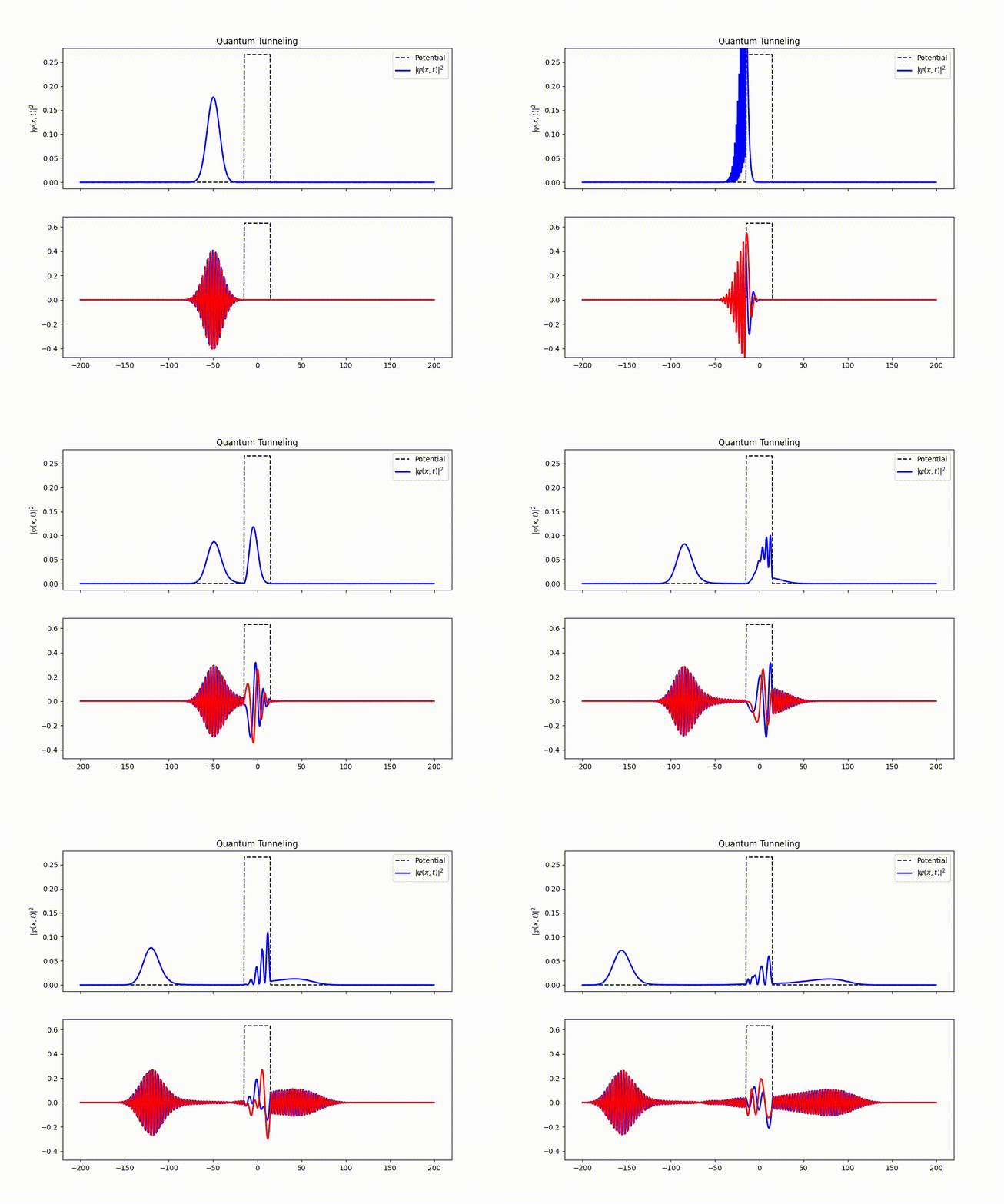
final prediction animation
Full code
def zero_1d_array(len: ℝ): ℝ[m]:
    results: ℝ[len] = for i: ℕ(len) -> i*0
    return results

def linspace(start: ℝ, end: ℝ, n: ℕ): ℝ[n]:
    x: ℝ[n] = zero_1d_array(n)
    dx: ℝ = (end - start) / (n - 1)
    for i:ℕ(0, n):
        x[i] = start + i * dx
    return x

def get_1d_array_length(x: ℝ[m]): ℝ:
    total: ℝ = 0
    temp: ℝ = 0
    for i:
        temp = x[i]
        total += 1
    return total

def get_2d_array_num_rows(x: ℂ[m, n]): ℝ:
    total: ℝ = 0
    temp: ℝ = 0
    for i:
        temp = x[i]
        total += 1
    return total

def zero_complex_2d_array(rows: ℝ, cols: ℝ): ℂ[m, n]:
    results: ℂ[rows, cols] = for i:N(rows) -> for j:N(cols) -> j * 1j
    return results

def append_row(x: ℂ[m, n], row: ℂ[n]): ℂ[k, n]:
    rows: ℝ = get_2d_array_num_rows(x)
    cols: ℝ = get_1d_array_length(x[0])
    new_rows: ℝ = rows + 1
    new_array: ℝ[new_rows, cols] = zero_complex_2d_array(new_rows, cols)
    for i:ℕ(0, rows):
        for j:ℕ(0, cols):
            new_array[i, j] = x[i, j]
    for j:ℕ(0, cols):
        new_array[rows, j] = row[j]
    return new_array

Nx: ℕ = 1024
Nt: ℕ = 3271
x: ℝ[Nx] = linspace(-200, 200, Nx)
dx: ℝ = 0.3910

hbar: ℝ = 1.0
mass: ℝ = 1.0

cfl_factor: ℝ = 0.2
dt: ℝ = cfl_factor * (mass * dx**2) / hbar
t_final: ℝ = 100.0

x0: ℝ = -50.0    # initial position
k0: ℝ = 2.0      # wavenumber (controls momentum)
sigma: ℝ = 10.0     # width of the wave packet

psi0: ℂ[Nx] = (1 / sigma*sqrt(3.14))**0.5 * exp(1j * k0 * x) * exp(-((x - x0)**2) / (2 * sigma**2))


def schrodinger_rhs(psi: ℂ[m], V: ℝ[n], dx: ℝ, hbar: ℝ, mass: ℝ): ℂ[o]:
    psi_xx: ℂ[Nx] = (roll(psi, -1) - 2*psi + roll(psi, 1)) / (dx**2)
    H_psi: ℂ[Nx] = -(hbar**2 / (2*mass)) * psi_xx + V * psi
    result: ℂ[Nx] = -1j / hbar * H_psi
    return result


def make_potential(V_value: ℝ): ℝ[m]:
    V: ℝ[Nx] = zero_1d_array(Nx)
    x: ℝ[Nx] = linspace(-200, 200, Nx)
    for i:ℕ(0, Nx):
        if abs(x[i]) < 15:
            V[i] = V_value
    return V


def RK4_step(psi: ℂ[m], dt: ℝ, V: ℝ[n], dx: ℝ, hbar: ℝ, mass: ℝ): ℂ[o]:
    k1: ℂ[Nx] = schrodinger_rhs(psi, V, dx, hbar, mass)
    k2: ℂ[Nx] = schrodinger_rhs(psi + 0.5 * dt * k1, V, dx, hbar, mass)
    k3: ℂ[Nx] = schrodinger_rhs(psi + 0.5 * dt * k2, V, dx, hbar, mass)
    k4: ℂ[Nx] = schrodinger_rhs(psi + dt * k3, V, dx, hbar, mass)
    psi_next: ℂ[Nx] = psi + (dt / 6.0) * (k1 + 2 * k2 + 2 * k3 + k4)
    return psi_next


def solver(V: ℝ[m]): ℂ[m, n]:
    x: ℝ[Nx] = linspace(-200, 200, Nx)
    psi0: ℂ[Nx] = ((1 / sigma*sqrt(3.14)) ** 0.5 * exp(1j * k0 * x) * exp(-((x - x0) ** 2) / (2 * sigma**2)))
    history: ℂ[1, Nx] = [psi0]
    counter: ℕ = 0
    psi = psi0
    for i:ℕ(0, Nt):
        psi = RK4_step(psi, dt, V, dx, hbar, mass)
        counter = counter + 1
        if counter == 5:
            history = append_row(history, psi)
            counter = 0
    return history


V: ℝ[Nx] = make_potential(1.8)
true_values: ℂ[m, n] = solver(V)
create_plot(true_values, psi0, x, V)

guess_barrier_height: ℝ = 6.0
guess_V: ℝ[Nx] = make_potential(guess_barrier_height)
guess_values: ℂ[m, n] = solver(guess_V)
create_plot(guess_values, psi0, x, guess_V)


def calculate_loss(barrier_height: ℝ): ℝ:
    V_current: ℝ[Nx] = make_potential(barrier_height)
    pred: ℂ[m, n] = solver(V_current)
    loss: ℝ = mean(abs(pred - true_values)**2)
    return loss


def adam(bh: ℝ, g: ℝ, m: ℝ, v: ℝ, t: ℝ, lr: ℝ) : ℝ[4]:
    beta1: ℝ = 0.9
    beta2: ℝ = 0.999
    eps: ℝ = 1e-8
    m_new: ℝ = beta1 * m + (1.0 - beta1) * g
    v_new: ℝ = beta2 * v + (1.0 - beta2) * g**2
    m_hat: ℝ = m_new / (1.0 - beta1**t)
    v_hat: ℝ = v_new / (1.0 - beta2**t)
    bh_new: ℝ = bh - lr * m_hat / (sqrt(v_hat) + eps)
    return [bh_new, m_new, v_new, t + 1.0]

m_adam: ℝ = 0.0
v_adam: ℝ = 0.0
t_adam: ℝ = 1.0
lr: ℝ = 0.1

epochs: ℕ = 40

for i:ℕ(epochs):
    physika_print(i)
    g = grad(calculate_loss, guess_barrier_height)
    result  = adam(guess_barrier_height, g, m_adam, v_adam, t_adam, lr)
    guess_barrier_height  = result[0]
    m_adam = result[1]
    v_adam = result[2]
    t_adam = result[3]

pred_V: ℝ[Nx] = make_potential(guess_barrier_height)
pred_results: ℂ[m, n] = solver(pred_V)
create_plot(pred_results, psi0, x, pred_V)